Dr. Edgerton worked as both an artist and a scientist, looking at ways in which the camera could freeze motion, much like Muybridge and Marey before him. There are several strands to his work, including studies of movement, high speed images and military work for the US governments nuclear weapons program. His work centers around the use of flash photography using an electric arc to create a momentary flash much shorter than conventional flashes of the time and even today. This is an example of technology enabling a particular way of seeing – without the stroboscope, even the camera could not see these images.

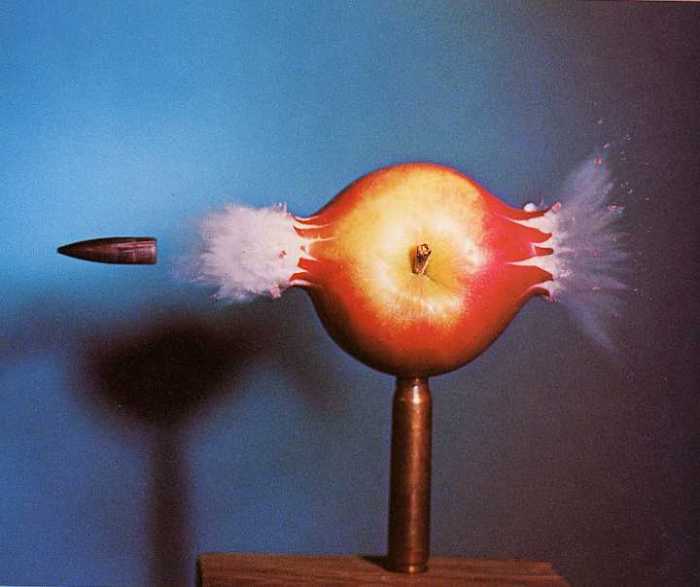
This example shows how a fast movement can be captured, this image uses an effective shutter speed of around 1/1,000,000 second, much faster than a regular camera’s maximum 1/1000 or a modern flash’s 1/20,000. When working with such high speeds we have to question everything we know about photography’s ability to freeze time, what we see as time, even in the fastest conventional images, is slow by a huge degree when compared to Edgertons’ imagery. If such a process existed that could show us time more finely than even Edgerton, and demonstrate the differences in the world that exist at these speeds, would we be able to appreciate time in the same way? From this we can explain that time is NOT a series of discreet events as we see in film and photography, but actually an infinitely moving and linear concept which cannot be described as a single moment, because the moment itself can be infinitely small.